Brain waves are the rhythmic electrical pulses generated by billions of neurons communicating within your brain. Think of them as a “neural symphony” where different frequencies—Delta, Theta, Alpha, Beta, and Gamma—represent different mental states, from deep sleep to high-stakes problem solving.

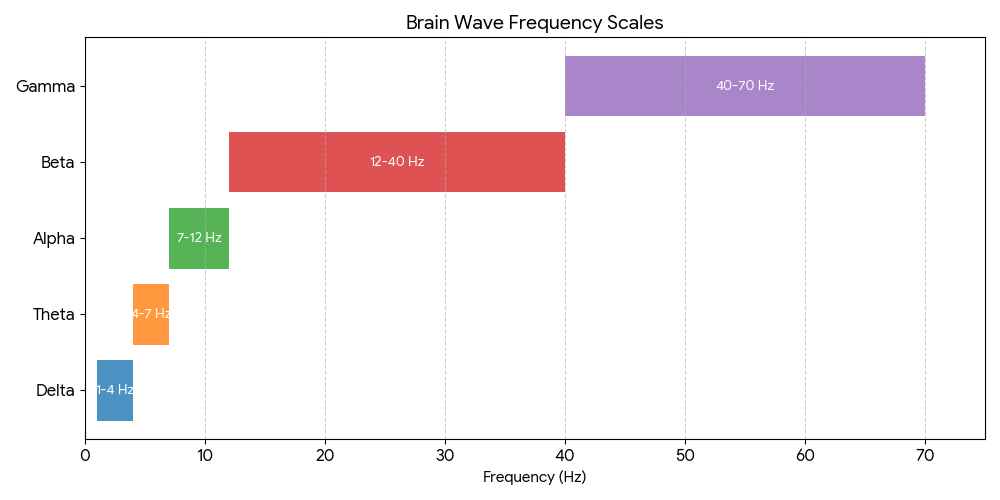
- δ Delta (1–4 Hz): The slowest waves with the highest amplitude. They dominate during deep, dreamless sleep (Stages 3 and 4) and are essential for physical healing, memory restoration via the hippocampus, and the release of growth hormones.
- θ Theta (4–7 Hz): Associated with light sleep, daydreaming, and REM sleep (vivid dreams). In a waking state, they appear during deep meditation and spiritual activity, facilitating creativity, intuition, and connection to the subconscious.
- α Alpha (7–12 Hz): These appear when you are awake but relaxed, particularly with your eyes closed (occipital lobe). They represent a “neutral” or “in-the-zone” state, reducing anxiety and boosting visualization and creative thinking.
- β Beta (12–40 Hz): The “active” brainwaves. They dominate during conscious reasoning, logical thinking, and problem-solving. While necessary for focus, excessive beta activity is linked to stress and anxiety.
- γ Gamma (40–70 Hz): The fastest waves, associated with “firing on all cylinders.” They relate to high-level information processing, happiness, compassion, and advanced learning.


Everything is energy and that’s all there is to it. Match the frequency of the reality you want and you cannot help but get that reality. It can be no other way. This is not philosophy. This is physics.
– Albert Einstein (note there are source claim, it is not true statement of Einstein)
Upanishad
The Mandukya Upanishad describes four states of consciousness represented by the syllables of A-U-M, which align closely with these neurological findings:
| Upanishad State | Description | Corresponding Brainwave |
| Jagrat (Waking) | External consciousness; active engagement with the world. | Beta & Alpha (Active reasoning and relaxed alertness). |
| Svapna (Dreaming) | Internal consciousness; the world of dreams and mental imagery. | Theta (REM sleep and vivid subconscious activity). |
| Sushupti (Deep Sleep) | Dreamless, unconscious state; total rest and restoration. | Delta (Deep, restorative, non-dreaming sleep). |
| Turiya (The Fourth) | Pure consciousness; the underlying state of all others. | Gamma (Integrated awareness and peak cognitive “unity”). |
Impact of age
Brainwave patterns shift significantly over time.
- Infancy (0-2 years): Dominantly Delta and Theta. This is why infants spend most of their time in a “sleep-like” or “dream-like” state of learning.
- Childhood (2-12 years): Theta and Alpha dominate. Children are naturally creative and “hypnotizable” because their Beta (logical/stress) waves haven’t fully developed.
- Adulthood: Beta becomes the dominant frequency. As we age, the “Alpha Peak Frequency” (the speed of our relaxation waves) tends to slow down by about 0.05–0.1 Hz per decade.
- Elderly: Research in Frontiers in Aging Neuroscience (2022) indicates that a significant drop in Gamma power is a precursor to Alzheimer’s. Conversely, maintaining high Alpha and Gamma through mental exercise correlates with “Super-Aging”—maintaining a 20-year-old’s memory in an 80-year-old’s body.

Measuring

- Clinical EEG: Used in hospitals to diagnose epilepsy, sleep disorders, and brain death.
- Quantitative EEG (qEEG): “Brain Mapping” used to compare your brainwaves against a database of healthy peers to identify ADHD, anxiety, or depression.
- Wearable Neurofeedback: Devices like Muse or Flowtime now allow users to see their brainwaves in real-time on a smartphone, bringing “biofeedback” into the home.

Modulate brain waves
- Meditation: Increases Alpha and Theta waves to enhance creativity and empathy, while focused techniques can boost Beta waves for problem-solving.
- Binaural beats: Uses frequency-shifting auditory illusions (one ear listens to one tone and the other listens to another with a slightly modified frequency) to slow brainwaves, promoting deep relaxation and rapid stress reduction.
- Music
- Supplements: neuro-nutrients and antioxidants
Modern approach
In a recent TEDx talk, Dr Mitchell Abrams explores the idea of “frequency medicine” — that light, sound and electromagnetic frequencies can be used non-invasively to influence physiology and healing. He emphasises the importance of coherence between heart, brain and body, and proposes that cultivating heart–brain coherence, compassion and mindful states can reduce pain perception and support resilience. This talk presents the speaker’s perspective on emerging approaches and how frequency-based therapies may complement traditional neuroscience.


 Guruprasad குருபிரசாத் விஜயராவ்
Leave a comment